

Ookla has released its latest regional analysis on Starlink, outlining how geography, regulation, and infrastructure continue to shape satellite broadband performance and adoption across Asia Pacific.
The findings build on Ookla’s 2025 Global Satellite Broadband Performance Report, which tracked Starlink’s presence in 155 countries, over 10 million subscribers, and 97.1% of global satellite Speedtest samples as of the third quarter of 2025.
Oceania Leads in Speed and Latency Performance
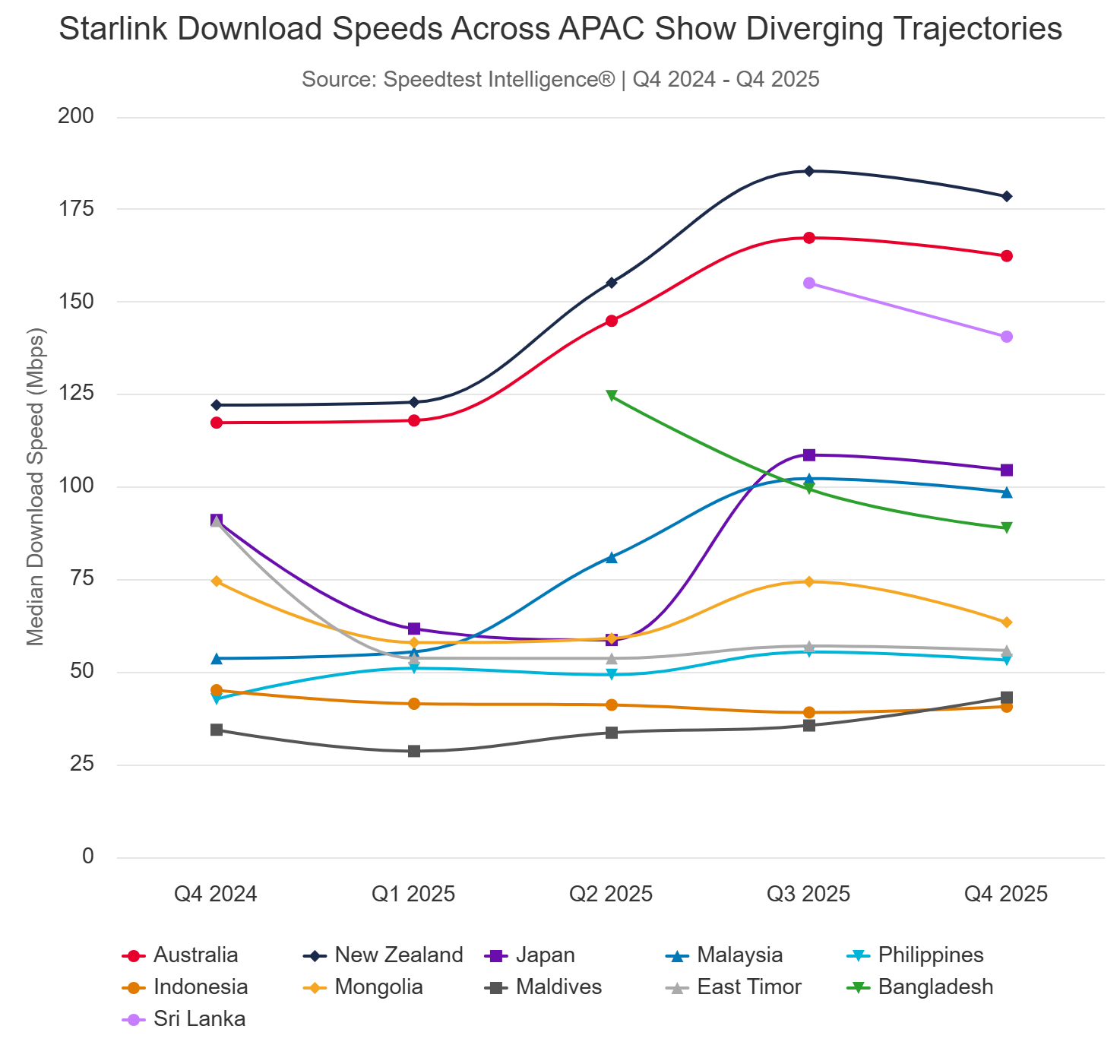
Across the region, Oceania continues to set the benchmark for satellite broadband performance. New Zealand recorded a multi-server latency of just 35ms in the fourth quarter of 2025, the lowest globally for Starlink, while Australia achieved median download speeds of 162.47 Mbps.
Both markets, which launched in April 2021, benefit from dense ground-station infrastructure, a factor Ookla identifies as critical to consistent performance. In contrast, markets without local gateways reported significantly higher latency, reaching up to 157ms in more remote areas.
Regulation Emerges as the Primary Barrier to Entry
Despite strong demand, Ookla notes that regulatory conditions, not market need, remain the biggest determinant of Starlink’s availability in Asia Pacific.
Countries such as Bangladesh and Sri Lanka required legislative reforms before approving satellite services, while India—the region’s largest untapped market—has yet to launch commercially despite securing key licenses in 2025.
Governments across the region have imposed varying requirements, including data localization, lawful interception compliance, and foreign ownership restrictions. These conditions have significantly influenced both the timeline and structure of Starlink’s market entry.
LEO Technology Reshapes Satellite Broadband Capabilities
Starlink’s low Earth orbit (LEO) network, operating at approximately 550 km above Earth, is redefining what satellite internet can deliver. Compared to traditional geostationary orbit (GEO) systems—such as those operated by Kacific—LEO dramatically reduces latency, enabling real-time applications like video calls, cloud computing, and online learning.
In the Philippines, GEO-based satellite services recorded latency as high as 599ms in 2025, highlighting the performance gap that LEO technology aims to close.
Geography Drives Demand Across Archipelagic and Rural Markets
The report underscores how geography continues to drive adoption, particularly in countries where terrestrial infrastructure is limited.
In Philippines and Indonesia, which together account for more than 24,000 islands, fiber rollout remains economically challenging. Similarly, low population density in Mongolia and remote island nations across the Pacific makes satellite connectivity a practical, and often the only, broadband solution.
As a result, Starlink has gained traction not only among residential users but also across enterprise and government sectors, including financial services and public infrastructure projects.
Pricing and Affordability Remain Key Challenges
While Starlink’s pricing remains relatively consistent globally, ranging from approximately $45 to $68 per month, the affordability gap varies widely across markets.
In the Philippines, for example, the service costs around PHP 3,800 per month, significantly higher than the average household internet spending of roughly PHP 1,069. Satellite broadband currently accounts for just 2.2% of connected households in the country.
Similarly, in Indonesia, entry-level pricing exceeds typical household internet budgets, limiting residential adoption despite strong demand in institutional sectors.
Performance Varies Widely Across Southeast Asia
Ookla’s data reveals uneven performance trends across Southeast Asia. Malaysia saw notable improvement, with median download speeds nearly doubling to 98.68 Mbps by late 2025. Meanwhile, the Philippines experienced more modest gains, reaching 53.27 Mbps.
In contrast, Indonesia recorded a slight decline in speeds, attributed to rising demand outpacing available network capacity.
Latency trends also mirror infrastructure deployment. Markets with local ground stations—such as Australia, New Zealand, and Bangladesh—achieved latency comparable to fixed broadband, while more remote regions continued to face delays due to reliance on distant gateways.
Market Growth Reflects Diverging Demand Patterns
Adoption trends across the region show mixed results. Indonesia recorded a 33.9% increase in active Starlink devices, driven largely by enterprise and government use cases. Mongolia posted the highest growth at 92%, reflecting its reliance on satellite connectivity for rural access.
However, Malaysia and the Philippines saw declines in active samples, linked to increased competition from expanding fiber networks and pricing adjustments, including a 40% price hike in the Philippines in 2025.
South Asia Emerges as a High-Growth Region
South Asia represents the newest growth frontier for Starlink. Bangladesh achieved median speeds of 88.95 Mbps and latency of 35ms within months of launch, while Sri Lanka reached 140.68 Mbps despite a delayed rollout due to regulatory disputes.
Both markets demonstrate how regulatory alignment and infrastructure investment can quickly translate into strong service performance.
Competition and New Technologies Shape the Next Phase
Looking ahead, competition in the region is intensifying. Amazon is preparing to introduce its LEO network through partnerships in Australia, while China’s Qianfan constellation is expanding through wholesale agreements in Southeast Asia and Central Asia.
Additionally, emerging technologies such as Direct-to-Device (D2D) satellite connectivity are expected to influence future licensing discussions, extending satellite services beyond fixed broadband into mobile communications.
Outlook: Growth Tied to Policy, Infrastructure, and Pricing
As Starlink continues its expansion across Asia Pacific, Ookla’s report highlights a clear pattern: market success depends less on demand and more on regulatory alignment, infrastructure deployment, and pricing strategies.
While the technology has already redefined satellite broadband capabilities, its long-term impact in the region will hinge on how effectively these factors are addressed across diverse markets.



Leave a Reply