

The Hackintosh community has long faced a deadline as Apple phases out legacy Intel support in favor of its Apple Silicon processors. A new open-source project named Stela is now working on an unexpected path forward by allowing unmodified Apple Silicon software to boot on standard x86 computers.
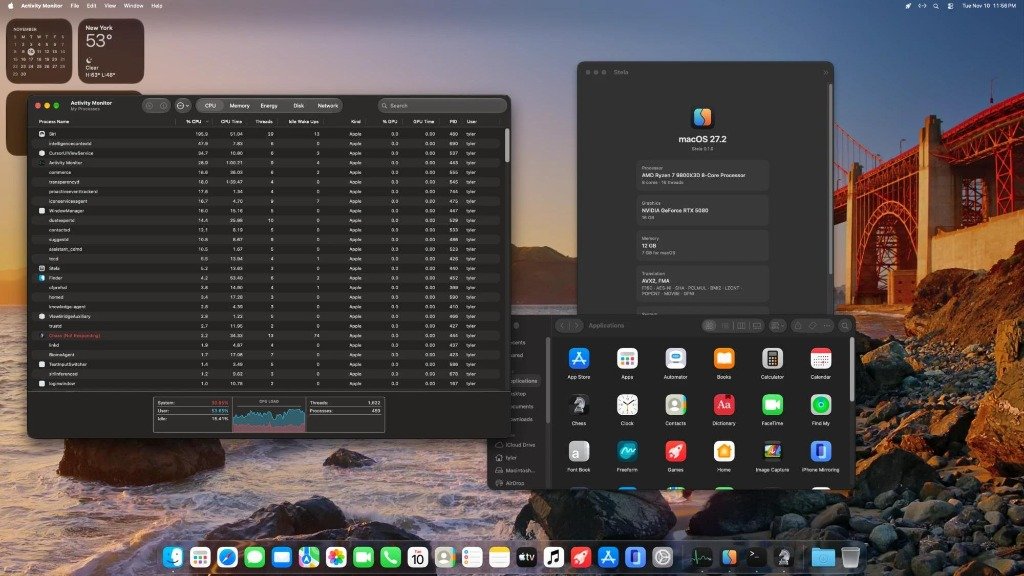
Bare-Metal UEFI Booting Without Traditional Kexts
Unlike traditional Hackintosh setups that rely on OpenCore configurations and complex kernel extensions, Stela takes a different engineering route. It runs as a standalone UEFI application that initializes hardware before the operating system kernel ever loads.
The system emulates the architectural behavior of an Apple Silicon machine, currently modeling an Apple Mac mini with an M2 processor. This structural approach allows modern arm64 macOS installations to boot directly without patching system binaries.
Translating AArch64 Machine Code to x86-64 Instructions
At the center of Stela is an ahead-of-time and just-in-time compiler pipeline designed to translate arm64e code to host x86-64 machine instructions. The engine covers more than 3,000 AArch64 instruction encodings, mapping guest registers directly to host registers while caching compiled blocks.
This translation layer is built to run on any processor supporting the x86-64-v2 instruction set, spanning AMD and Intel CPUs manufactured roughly from 2011 onward.
While developer testing confirms that the desktop interface, core utilities, and command-line tools like Homebrew can launch, overall performance remains slow in this early proof-of-concept phase.
Custom Metal Driver for Modern NVIDIA GeForce GPUs
Graphics acceleration presents one of the largest technical hurdles when running modern macOS on personal computers. Apple discontinued official NVIDIA graphics support years ago, leaving newer GPU architectures stranded on Hackintosh builds.
Stela addresses this barrier by providing an open-source Metal driver tailored for NVIDIA GeForce GTX 16-series, RTX 20-series, and newer GPUs based on the open Nouveau framework. The driver translates Apple Intermediate Representation shader code directly into Mesa NIR, bringing support for the Metal 3 and Apple 7 graphics families.
The creator also noted that future development milestones aim to introduce broader driver stacks for AMD Radeon GPUs and Intel integrated graphics.
Early Experimental Status and Hardware Requirements
Testers should keep expectations low because version 0.1.0 is strictly an exploratory developer release. The project author cautions that boot success rates remain low and that substantial hardware fixes are still in progress.
Installation requires a minimum of 8GB of RAM, an empty 60GB GPT disk partition, an 8GB USB drive, and an active network connection to download installation packages.
Stela is licensed under the GPL-2.0-or-later license and contains no proprietary Apple code. Users can inspect the full source code and follow updates directly on the official tylertms Stela repository on GitHub.
| Feature / Requirement | Details |
|---|---|
| Project Name | Stela (Version 0.1.0) |
| Author / Repository | Tyler Smith (tylertms/Stela on GitHub) |
| License | GNU General Public License v2.0 or later (GPL-2.0-or-later) |
| Target Architecture | Apple Silicon (arm64 / arm64e) translated to x86-64 |
| Modeled Hardware | Apple Mac mini (M2 profile) |
| Tested OS Version | macOS 27 (macOS 27.2 build demonstration) |
| Processor Support | Any x86-64-v2 CPU (AMD or Intel from 2011 onward) |
| Graphics Support | NVIDIA GeForce GTX 16-series, RTX 20-series, and newer (Metal 3 / Apple 7) |
| Minimum System Requirements | 8GB RAM, 60GB empty GPT partition, 8GB USB drive, UEFI with Secure Boot off |
| Photo Credit | @mdaman010 on X via tylertms/Stela GitHub and r/hackintosh |
Leave a Reply